There is a sentence that changes the conversation immediately when a patient with a thyroid lump hears it from their surgeon: “The good news is that thyroid cancer is the most curable solid-organ cancer in existence — but only if it is managed correctly.”
That sentence contains both reassurance and a critical warning. Thyroid cancer treatment in Ahmedabad, when performed by an experienced head and neck surgeon with the right training and the right techniques, delivers remarkably high long-term cure rates. The well-differentiated thyroid cancers that account for the vast majority of cases have 10-year survival rates exceeding 95%. But poorly selected operations — incomplete thyroid surgery, missed lymph node disease, inadequate follow-up — compromise those outstanding numbers significantly.
At Anahat Oncology, Dr. Vishal Choksi — Fellow of the American Head and Neck Society (AHNS), trained at Memorial Sloan Kettering Cancer Center, and certified by the American Board of Surgeons — provides the complete spectrum of thyroid cancer surgical treatment in Ahmedabad with the precision that this highly treatable but technique-sensitive cancer demands.
Types of Thyroid Cancer: Understanding Your Diagnosis
Not all thyroid cancers are the same. Your treatment plan depends critically on which type has been diagnosed.
Papillary Thyroid Carcinoma (PTC) — 80% of All Cases
The most common thyroid cancer and the most favourable. Even when it spreads to neck lymph nodes (which it frequently does), cure rates remain extremely high. Responds excellently to surgery and radioactive iodine (RAI).
Follicular Thyroid Carcinoma (FTC) — 10% of Cases
Tends to spread via the bloodstream (haematogenous) rather than lymph nodes — lung and bone are the most common distant metastatic sites. Generally more aggressive than papillary thyroid cancer but still highly treatable.
Hürthle Cell Carcinoma — 3–4%
A subtype of follicular carcinoma with more aggressive behaviour and reduced RAI responsiveness. Requires careful surgical planning and close follow-up.
Medullary Thyroid Carcinoma (MTC) — 3–4%
Arises from the parafollicular C-cells that produce calcitonin. Does NOT respond to radioactive iodine — surgery is the only curative treatment. Can be hereditary (associated with MEN2 syndrome); genetic testing of family members is recommended.
Anaplastic Thyroid Carcinoma — <2%
The most aggressive and most lethal thyroid cancer. Fortunately very rare. Requires urgent multidisciplinary management. Survival is measured in months, making rapid diagnosis and specialist referral critical.
Warning Signs of Thyroid Cancer in Ahmedabad
Most thyroid cancers are discovered as incidental findings — on ultrasound done for another reason or as a lump noticed during a routine examination. However, the following should prompt immediate evaluation:
- A painless lump or swelling in the neck — particularly if firm or growing
- Hoarseness — voice change may indicate vocal cord involvement by the tumour or nodal disease
- Difficulty swallowing — from tracheal or oesophageal compression
- Neck lymph node enlargement — particularly in the central or lateral neck
- Rapid growth of a previously stable neck mass
- Family history of medullary thyroid cancer or MEN syndrome
Diagnosing Thyroid Cancer: The Steps to a Confirmed Diagnosis
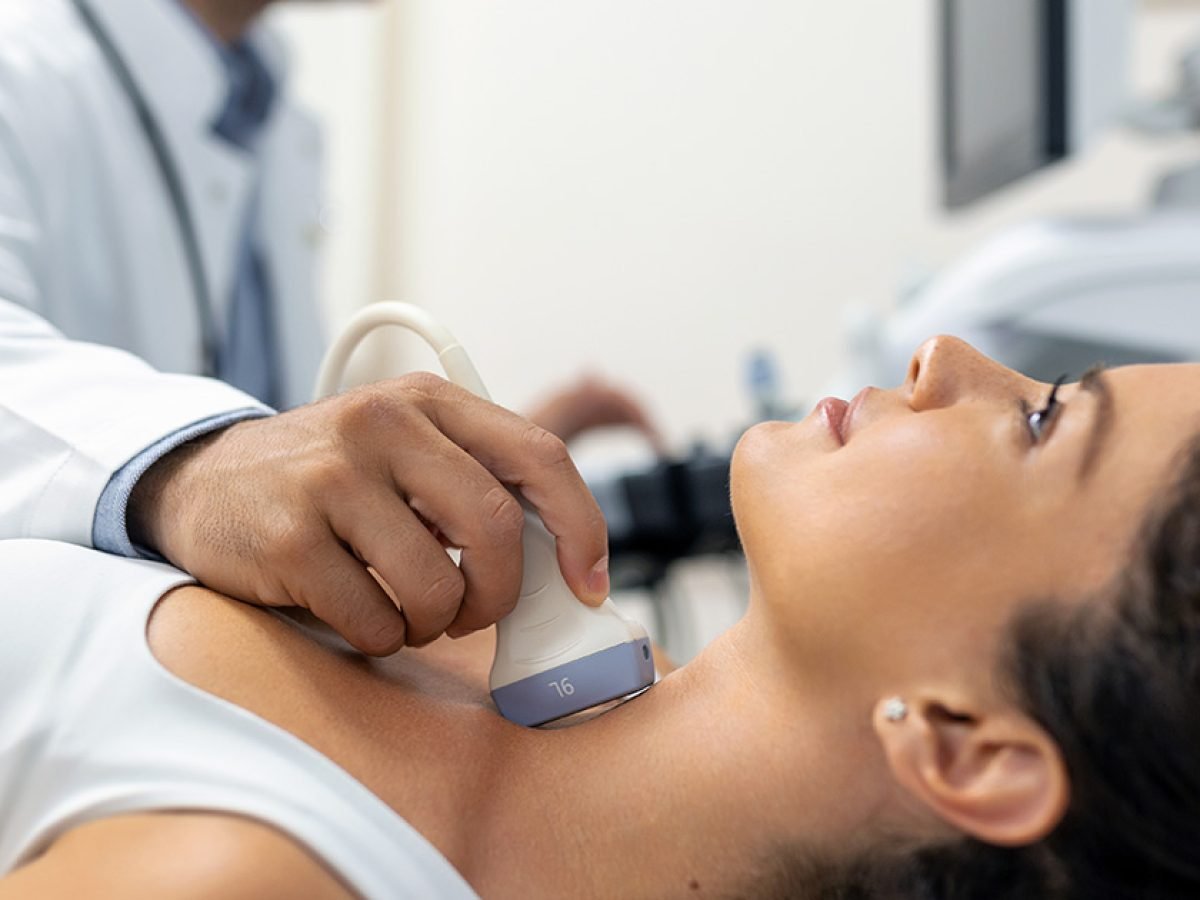
Thyroid ultrasound The first-line investigation. Characterises the nodule — its size, composition (solid vs. cystic), internal vascularity, calcification, and suspicious features (hypoechogenicity, microcalcifications, irregular borders, taller-than-wide shape). Guides the decision for biopsy.
Ultrasound-guided Fine Needle Aspiration Cytology (FNAC) A needle is passed into the thyroid nodule under ultrasound guidance — obtaining cells for cytological assessment. Classified by the Bethesda system (I–VI), which guides the next steps.
Molecular testing For indeterminate Bethesda III/IV lesions, molecular markers (BRAF, RET/PTC, Afirma gene expression) help predict malignancy probability and guide surgical extent.
Staging CT scan of neck and chest Assesses lymph node involvement, tracheal invasion, and lung metastases — essential for surgical planning.
Serum calcitonin Should be measured when MTC is suspected or in any patient with family history of MEN syndrome.
Thyroid Cancer Surgery in Ahmedabad: What the Operation Actually Involves
Thyroidectomy — Total vs. Hemithyroidectomy
Total thyroidectomy — surgical removal of the entire thyroid gland — is the standard operation for:
- Papillary thyroid cancer >1 cm
- Any tumour with evidence of lymph node metastasis
- Follicular thyroid carcinoma
- Medullary thyroid carcinoma
- Any bilateral thyroid cancer
Hemithyroidectomy (thyroid lobectomy) — removal of only the lobe containing the tumour — may be appropriate for:
- Low-risk papillary microcarcinoma (≤1 cm, no lymph node involvement)
- Selected indeterminate nodules where malignancy is possible but not confirmed
Central Neck Dissection
The lymph nodes between the carotid arteries and around the trachea are at highest risk of metastasis in papillary thyroid cancer. Removal of these central compartment nodes (Level VI) is performed prophylactically or therapeutically depending on the extent of disease.
Lateral Neck Dissection
When clinical or radiological evidence of lateral neck lymph node metastasis exists, a selective neck dissection (Levels II–V) is performed through a separate neck incision on the affected side.
The Critical Technical Demands of Thyroid Surgery
The thyroid sits in intimate contact with structures that, if damaged, cause significant morbidity:
- Recurrent laryngeal nerves (RLN) — run in the groove between the trachea and oesophagus, directly adjacent to the thyroid. Damage causes permanent hoarseness and, if bilateral, airway compromise.
- External branch of the superior laryngeal nerve (EBSLN) — controls the highest-pitched voice register; damage causes a subtle but professionally significant voice change.
- Parathyroid glands — four tiny glands on the thyroid surface that control calcium metabolism. Accidental removal or devascularisation causes hypoparathyroidism — permanent low calcium.
Intraoperative nerve monitoring (IONM) — the use of continuous electrical stimulation and monitoring of the RLN throughout surgery — significantly reduces the risk of nerve injury and is standard practice in Dr. Choksi’s thyroid surgery.
For related parathyroid conditions, see: Parathyroid Adenoma Surgery in Ahmedabad
Radioactive Iodine (RAI) After Thyroid Surgery
RAI (iodine-131) therapy is used after total thyroidectomy for:
- Intermediate and high-risk well-differentiated thyroid cancers
- Patients with known distant metastases
- To facilitate sensitive surveillance using thyroglobulin as a tumour marker
How RAI works: The thyroid is the only tissue in the body that absorbs iodine. After total thyroidectomy, any residual thyroid tissue — normal or malignant — absorbs the radioactive iodine and is destroyed. This eliminates residual microscopic disease and enables thyroglobulin-based monitoring.
RAI is NOT effective for medullary thyroid carcinoma (which does not absorb iodine) or anaplastic thyroid carcinoma.
Long-Term Follow-Up After Thyroid Cancer Treatment
Thyroid cancer has an excellent prognosis — but requires structured lifelong follow-up:
- Thyroid hormone replacement — all patients after total thyroidectomy require daily levothyroxine; in high-risk patients, TSH suppression is used to reduce TSH-stimulated cancer growth
- Thyroglobulin monitoring — a sensitive tumour marker that rises if cancer recurs
- Neck ultrasound — periodic surveillance for nodal recurrence
- Whole body scan — used selectively to detect distant RAI-avid metastases
- Calcitonin monitoring — for medullary thyroid carcinoma
Conclusion: Expert Thyroid Cancer Treatment in Ahmedabad at Anahat Oncology
Thyroid cancer treatment in Ahmedabad requires a surgeon who understands not just how to remove the thyroid, but how to protect the nerves and parathyroids around it — and how to plan the complete treatment pathway from surgery through RAI and long-term surveillance.
As a fellowship-trained thyroid cancer surgeon in Ahmedabad with Memorial Sloan Kettering training, Dr. Vishal Choksi delivers precisely this expertise — ensuring that every thyroid cancer patient receives not just adequate surgery, but the complete, protocol-driven treatment plan that maximises both cure and quality of life.
Book Your Thyroid Cancer Consultation at Dr. Vishal Choksi
A thyroid lump that needs assessment. A recent biopsy result that needs interpretation. A diagnosis that needs a specialist’s second opinion.
+91 079 26468666 | +91 97277 03693

Leave a comment