Salivary Gland Cancer in Ahmedabad
A painless lump in front of the ear or under the jaw is often a salivary gland tumor. Most of these are benign, but they still need removal by an experienced surgeon, because the facial nerve – which moves your face – runs through the parotid gland. This page explains salivary gland tumors and salivary gland cancer in Ahmedabad, how they are diagnosed, and how Dr. Vishal Choksi, a Memorial Sloan Kettering–trained head and neck cancer surgeon and salivary gland cancer surgeon in Ahmedabad, removes them while protecting facial movement.
Lump near the ear or under the jaw? Book an evaluation: +91 97277 03693
Salivary Gland Cancer in Ahmedabad: Quick Facts
Question | Answer |
Most common site | The parotid gland, in front of and below the ear |
Is every lump cancer? | No – about four out of five parotid tumors are benign |
Most important structure at risk | The facial nerve, which moves the face |
Main treatment | Surgery (parotidectomy or gland excision), with radiation for higher-risk cancers |
Best tests before surgery | Ultrasound or MRI with a needle biopsy (FNAC or core) – not an open biopsy |
Surgeon | Dr. Vishal Choksi – MSKCC-trained head and neck surgeon, Apollo Ahmedabad |
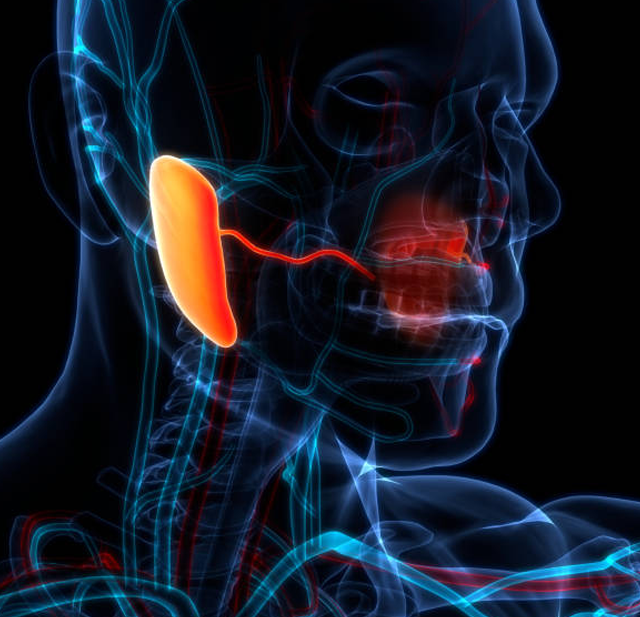
Where Are the Salivary Glands?
- Parotid glands – the largest, in front of and below each ear. About 70–80% of salivary tumors start here, and most parotid tumors (roughly four out of five) are benign.
- Submandibular glands – under the jaw on each side. Tumors here are less common, but a higher proportion are cancerous.
- Sublingual glands – under the tongue. Tumors are rare but frequently malignant.
- Minor salivary glands – hundreds of tiny glands in the lining of the mouth, palate and throat. Tumors here are often malignant and may look like oral cancer.
Types of Salivary Gland Tumors
Tumor | Benign or malignant | Notes |
Pleomorphic adenoma | Benign | Most common; should be removed because it keeps growing and can rarely turn malignant after many years |
Warthin tumor | Benign | Common in older smokers; can occur on both sides |
Mucoepidermoid carcinoma | Malignant | Most common salivary cancer; low, intermediate or high grade |
Adenoid cystic carcinoma | Malignant | Slow-growing but tends to spread along nerves; needs long follow-up |
Acinic cell and other carcinomas | Malignant | Behaviour depends on type and grade |
Salivary duct carcinoma | Malignant | Aggressive; needs combined treatment |
Symptoms of Salivary Gland Tumors
Benign tumors usually cause:
- A slow-growing, painless lump in front of the ear, below the ear or under the jaw
Warning signs that suggest cancer:
- Rapid growth
- Pain in the lump
- Weakness or drooping of one side of the face
- Numbness of the face
- A lump that feels fixed to the skin or deeper tissues
- Enlarged lymph nodes in the neck
- Difficulty opening the mouth
When to See a Salivary Gland Cancer Specialist Doctor in Ahmedabad
Any lump in front of the ear, below the ear or under the jaw that lasts more than two to three weeks should be examined – even if it is small and painless. See a specialist urgently if you notice:
- Weakness of the face, difficulty closing the eye or a drooping corner of the mouth
- A lump that has grown noticeably over a few weeks
- Pain in the lump or numbness of the face
- A lump that feels hard or fixed
- New lumps lower down in the neck
Swelling that comes and goes with meals is more often caused by a stone or infection in the gland, but it still needs assessment. At the first visit the specialist examines the face, mouth and neck, checks facial nerve movement, and arranges ultrasound, MRI and a needle biopsy as needed.
How Salivary Gland Tumors Are Diagnosed
- Examination of the gland, face, mouth and neck, including facial nerve function.
- Ultrasound of the gland and neck.
- Fine-needle aspiration cytology (FNAC) or core biopsy – reported using the Milan system for salivary gland cytopathology. Open biopsy of a parotid lump should be avoided because it can spread tumor cells.
- MRI – the best scan to show the tumor’s extent and its relationship to the facial nerve; CT or PET-CT for cancers.
Salivary Gland Cancer Treatment in Ahmedabad
Surgery
Surgery is the main treatment for both benign and malignant salivary gland tumors.
- Superficial or partial parotidectomy: removal of the tumor with the part of the parotid gland above the facial nerve. The nerve is identified and preserved throughout. This is the usual operation for benign parotid tumors.
- Total parotidectomy: removal of the whole gland for tumors in the deep lobe or for cancers, still preserving the facial nerve whenever it is not invaded.
- Submandibular gland excision: removal of the gland through an incision under the jaw.
- Neck dissection: for cancers with lymph node spread or high-grade cancers.
- Facial nerve repair: if cancer has invaded the nerve and part must be removed, a nerve graft and facial reanimation procedures can restore movement and eye closure.
Radiation therapy
Radiation after surgery is recommended for high-grade cancers, advanced tumors, close or involved margins, nerve invasion, or lymph node spread. This is planned with radiation oncology.
Systemic therapy
Chemotherapy, targeted therapy (for tumors with specific markers such as HER2 or androgen receptors) and clinical trials are options for advanced or recurrent disease.
Tumors that extend toward the base of the skull are managed with the skull base team.
Facial Nerve: Your Most Important Question
The facial nerve controls eye closure, smiling and facial expression. In benign parotid surgery by an experienced surgeon, permanent facial weakness is uncommon. Temporary weakness of part of the face can occur for a few weeks to months after surgery, especially after deep-lobe or revision surgery, and usually recovers fully. Nerve monitoring during surgery may be used as an additional aid.
Other Effects After Parotid Surgery
- Numbness of the ear lobe, which improves over months
- Frey’s syndrome – sweating over the cheek while eating, which can be treated if troublesome
- A small hollow in front of the ear, which can be reduced with reconstruction techniques
- Saliva collection under the skin (sialocele), which usually settles
Choosing the Best Salivary Gland Specialist in Ahmedabad
Parotid surgery is technically demanding because the facial nerve must be found and followed through the gland. Look for a salivary gland cancer specialist doctor in Ahmedabad who:
- Performs parotid surgery regularly as part of a head and neck practice
- Uses MRI and cytology to plan surgery before operating
- Offers neck dissection, facial nerve repair and radiation within one team
- Explains the risk to the facial nerve honestly for your specific tumor
Why Choose Dr. Vishal Choksi as Your Salivary Gland Cancer Doctor in Ahmedabad
- Head and neck surgery fellowship at Memorial Sloan Kettering Cancer Center, New York
- More than 20 years of experience in parotid, submandibular and neck surgery
- Facial nerve–preserving surgery as the standard approach
- Multidisciplinary care at Apollo Ahmedabad for salivary cancers
Read about Dr. Vishal Choksi.
Recovery After Parotid and Salivary Gland Surgery
After parotidectomy, most patients stay one to two days. A small drain is removed before discharge. Stitches are removed in about a week, and most people return to work within one to two weeks. Follow-up for benign tumors checks for recurrence; for cancers, follow-up continues for many years, especially for adenoid cystic carcinoma.
Frequently Asked Questions About Salivary Gland Tumors
Is a lump in front of the ear cancer?
Usually not. Most parotid lumps are benign tumors such as pleomorphic adenoma or Warthin tumor. Still, every parotid lump should be evaluated with ultrasound or MRI and FNAC.
Does a benign parotid tumor need surgery?
Pleomorphic adenomas should be removed because they grow slowly over time and can rarely become malignant after many years. Some Warthin tumors in elderly patients may be observed.
Will my face be paralysed after parotid surgery?
Permanent facial paralysis is uncommon when an experienced surgeon removes a benign tumor. Temporary weakness can occur and usually recovers within weeks to months.
What is the most common salivary gland cancer?
Mucoepidermoid carcinoma is the most common, followed by adenoid cystic carcinoma.
Is salivary gland cancer curable?
Many salivary cancers, especially low-grade ones treated with complete surgery, are curable. High-grade cancers need surgery and radiation and closer follow-up.
Why should a parotid lump not be cut open for biopsy?
An open biopsy can spill tumor cells and increase recurrence. A needle biopsy (FNAC or core) is the safe method.
How long does parotid surgery take?
Usually two to three hours, depending on the size and position of the tumor.
Will I need radiation after salivary gland surgery?
Radiation is usually not needed for benign tumors. It is recommended for many cancers depending on grade, stage and margins.
What is Frey’s syndrome?
Sweating and flushing of the cheek while eating, caused by nerve fibres regrowing after parotid surgery. It is often mild and treatable.
Can salivary gland tumors come back?
Benign tumors can recur if they were not completely removed, which is why proper parotidectomy is preferred over simply shelling out the lump.
How do I consult a salivary gland cancer specialist in Ahmedabad?
Call +91 97277 03693 or +91 79 2646 8666 and bring your ultrasound, MRI and FNAC reports.
Sources
- NCI – Salivary Gland Cancer Treatment (PDQ)
- NCCN Guidelines – Head and Neck Cancers (includes salivary gland tumors)
- WHO Classification of Head and Neck Tumours, 5th edition
Author & Medical Review
Dr. Vishal Choksi, MBBS, Diplomate American Board of Surgery, AHNS Fellow. Medically reviewed by Dr. Vishal Choksi.